



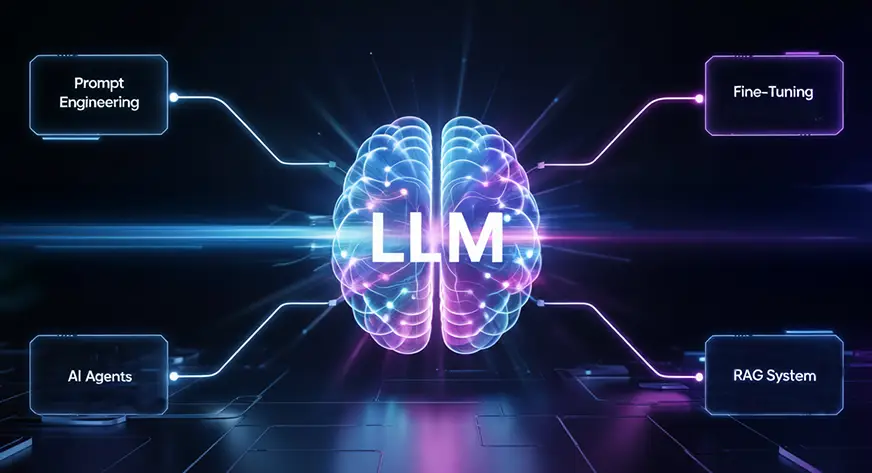
The gap between a generative AI demonstration and a system that performs reliably in enterprise production is often bridged by one critical technical capability: LLM Fine-Tuning for Enterprise. Without domain adaptation, even the most capable foundation models produce outputs that are generic, occasionally inaccurate, and poorly aligned with enterprise requirements. Fine-tuning transforms a powerful but generic model into a precise, reliable enterprise tool — and it is a cornerstone of the best Generative AI Services and Solutions available today.
The Case for Fine-Tuning
Foundation models are trained on broad, internet-scale datasets. They develop remarkable general capabilities but lack the specific knowledge, terminology, and behavioural patterns required for most enterprise applications. LLM Fine-Tuning for Enterprise addresses this by training the model on domain-specific examples — teaching it the vocabulary, standards, and quality expectations of the target organisation and use case.
Fine-Tuning Techniques
LLM Fine-Tuning for Enterprise encompasses a family of techniques suited to different requirements. Full fine-tuning updates all model parameters and achieves the deepest domain adaptation but requires significant compute. Parameter-efficient methods like LoRA and QLoRA achieve substantial adaptation by updating only a fraction of parameters — making fine-tuning viable for organisations without large-scale GPU infrastructure. Instruction fine-tuning shapes model behaviour to follow specific task formats, while RLHF aligns outputs with human quality standards.
Fine-Tuning Within the Services Ecosystem
LLM Fine-Tuning for Enterprise is most effective when embedded within a comprehensive set of Generative AI Services and Solutions — not treated as a standalone activity. Fine-tuning decisions should be informed by careful use case analysis; training data should be prepared according to rigorous data engineering standards; and the fine-tuned model should be evaluated against business-specific quality criteria before deployment.
Measuring Fine-Tuning Success
The success of LLM Fine-Tuning for Enterprise must be measured in business terms, not just technical benchmarks. Generative AI Services and Solutions providers who take this seriously will establish baseline performance metrics before fine-tuning, run controlled evaluations after fine-tuning, and track business outcomes — accuracy, efficiency, user satisfaction — in production.
Conclusion
LLM Fine-Tuning for Enterprise is the technical capability that converts the general promise of large language models into specific, reliable business value. Embedded within quality Generative AI Services and Solutions, it is the engine of AI performance that sophisticated enterprise buyers should prioritise when evaluating implementation partners.
