



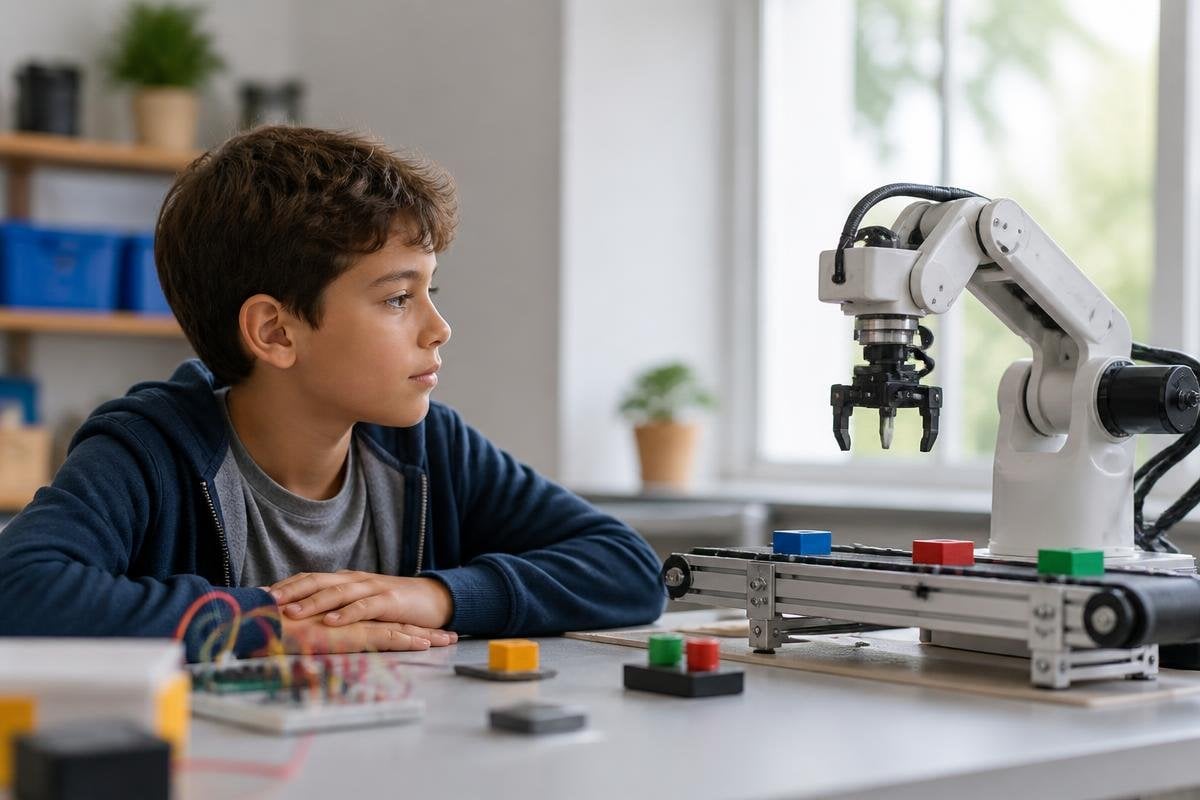
A child may meet automation in a game, a delivery center, a hospital, or the family home. Understanding how these systems sense, decide, and act helps them ask better questions about the machines around them.
- Automation follows rules, data, or both
- People still set goals and limits
- A working system can still make mistakes
Automation is more than robots
Automation means a system carries out a task with limited human control. The system might sort packages, adjust a heating system, check a car’s position, or move a robot arm. A physical robot is only one form of automation.
That wider view matters because children can miss automation when they expect every machine to have arms or wheels. A recommendation in an app, a sensor that turns lights on, and a machine that checks products can all follow the same basic pattern.
These systems collect information, apply rules, and produce an action. Children don’t need advanced mathematics to begin. They can start by asking what the system can sense, what instructions it follows, and what happens when the input is wrong. Those questions make an invisible process easier to see.
People still make the important choices
A machine can repeat a task quickly, but someone decides what task matters and what result counts as acceptable. People choose the data, write or select the rules, check the output, and decide when the system should stop.
That gives children a useful way to separate ability from responsibility. A sorting machine may identify an object by its size or shape. It cannot decide whether the wider goal is fair, safe, or suitable for a particular person without human direction.
I think automation should be taught as a subject for careful questions, not as a promise that machines will solve every problem.
The same lesson applies to software. A system can give an answer that looks neat while using poor information or missing an important detail. Asking “How did it reach that result?” is more useful than treating a machine’s answer as final.
Small projects make the idea clear
Children understand automation faster when they can change one part of a system and watch the result. A simple project might use a light sensor, a motor, or a block-based program. The lesson is the link between an input and an action.
For example, a child could set a light to turn on when a sensor detects darkness. They can then cover the sensor, move the light, or change the rule. Each change shows that automation depends on conditions. It also shows why testing matters.
Projects should include a failure to investigate. If the light turns on at the wrong time, the child can check the sensor, the rule, or the connection. That process teaches a practical habit: find the part that made the decision before blaming the whole system.
Dated reports on automation from Robot24.com can give teachers real machines and test results to bring into class. A sensor failure or a robot stopping at a boundary makes the next lesson clear: automation needs rules for when it should stop.
The limits belong in the lesson
Automation can save effort, repeat a process, and help people handle tasks that are dull or unsafe. It can also make a wrong choice many times if its rules or data are wrong.
Children should learn that a sensor has limits, a program follows its instructions, and a robot works within its design. A machine that performs well in one room may struggle when the light, surface, object, or task changes.
This does not mean children need to fear automation. It means they need enough knowledge to check a machine’s work, protect private information, and ask who is responsible when something goes wrong.
A simple starting plan
Use these steps to turn ordinary machines into lessons about automation:
- Pick one system at home, such as an automatic light or thermostat.
- Ask what information the system receives before it acts.
- Change one condition and watch whether the result changes.
- Write down one task the system handles well.
- Name one case where a person should check the result.
The discussion can grow with the child. Younger children can sort actions into “the machine decides” and “a person decides.” Older children can compare two rules, question the data behind a result, or design a safer stop condition.
The goal is practical knowledge. A child who can see the inputs, rules, limits, and human choices behind automation will be better prepared to use these systems carefully as they become part of more work, services, and daily tasks.
